 Image via Wikipedia Image via Wikipedia |
| The "Scarborough" - it's not actually my ferry! |
You may note that it seems government bodies are particular culprits in this type of language bastardisation (should that be a surprise?). But I first noticed the trend when working at “My Store Myer” back in my student days. Myer may well have begun the awful fad with their, “My fashion must-haves”, “my store for electrical” and “mystyle”, “mytoys”, “myhome” and “mychristmas” catch-phrases and catalogue titles. I’ve recently changed phone companies for my mobile phone and I’ve noticed that when checking my account balance with Optus my new phone provider a computerised voice will say to me in that stilting stop-start way that computers have when they mix and match different snippets of a prerecorded message:
“Your Optus Prepaid balance is one hundred and thirty dollars. Which is made up of twenty-eight dollars worth of MyCredit and one hundred and two dollars worth of MyBonus.”
What do you mean my balance is made-up of twenty eight dollars of your credit? So whose credit is it then? Yours or mine? Surely it would just be simpler to drop the redundant “my” and tell me that I have $28 credit and $102 bonus.
Doesn’t this gratuitous use of the word “my” just grate on everyone’s nerves when they hear it? It’s ugly from a language point of view and I think it’s ugly from a societal point of view too.
Incorporating an unnecessary determiner (in this case “my”) into the proper nouns for different products and services, a determiner which is devoid of all meaning in its new home, is ugly from a language point of view because unlike adjectives, determiners (such as articles, the, a, etc.; demonstratives, these, those etc.) are meant to carry a specific contextual meaning which can differ in different sentences notwithstanding the fact that the determiner might be preceding the exact same object. For example is it you referring to the object or me? Is it one of a kind or one of many? Do you own it, do I own it or does someone else own it?
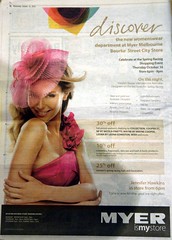 Image by avlxyz via Flickr Image by avlxyz via Flickr |
| An advertisement in the publication mX for the department store "Myer" |
“What cologne is that? I might take it.”
“That’s His?”
“Whose? Oh, sorry, if I knew it belonged to someone else I wouldn’t have taken it?”
“No, it’s His - that’s the name of the fragrance.”
“What?”
“It’s His by Calvin Klein.”
“Now that sentence has only one grammatically sensible meaning and it implies either two men achieving something which I’m certain is biologically impossible or that Calvin Klein is in fact a woman!”
But I’m getting side-tracked. The real point that I want to make is that this horrible trend of tacking a “my” onto the name of all sorts of products and services is ugly and stupid because despite the best efforts of advertising executives we’ll still have to recognise the sad fact that not everything in the world belongs to us. And thus, if we spoke as admen and marketing types would have us speak, then we’d be forced to add another determiner in front of theirs. Just so we know that it’s my MyPetpeeve and not your MyPetpeeve - if you have any MyPetpeeve that is, or if you were going to get some MyPetpeeve for your sister, even if she didn’t want any of the MyPetpeeve because then with our extra determiner we would be sure it was her MyPetpeeve and not think that everyone else was stealing what I thought was my pet peeve!


