Aboriginal Rock Carvings - Bondi

Image via Tom Häkkinen
A rock carving of a shark
I should probably preface this article with a short address of some racist attitudes held in Australia. Ancient Aboriginal historical sites, like those in Sydney, have long been under-appreciated and dismissed, largely because of the ideological view, stemming from Terra Nullius, that Aboriginal people “never did anything with the land”. Comments, like the then Immigration Minister Philip Ruddock’s in the year 2000 to the Washington Post that described Aboriginal disadvantage by referring to them not having “agriculture” or developing “the wheel” just demonstrate how widespread this ideological view still is. Of course, Anglo-Saxons have been forcing other people off of their land for a lot longer than they have been able to justify such evictions with reference to their contributions to human technology. The Britain of the Britons already had cities, roads and farms, already had London in fact! According to Tim Flannery, agriculture developed independently in five different regions on Earth and you will find included in his list neither Europe nor Australia.

Image via Tom Häkkinen
The rock carvings are situated on a site with good natural
architecture for ceremonial rituals.
Which is all to say that visiting different countries’ historical sites shouldn’t be about comparing cultures, but rather about marvelling at human ingenuity in the face of an often cruel and unforgiving Mother Nature. So I invite my readers to engage their imaginations when appreciating these photos of Aboriginal rock carvings and try to imagine an ancient ceremonial site, where people gathered from miles around, at a certain time of the year, to celebrate a now long forgotten ritual and in the days of that celebration feed off of the bounty of the sea, relaxing at nearby Bondi beach and performing ritual dances and storytelling in the balmy night of a hot Sydney summer.

Image via Tom Häkkinen
You can see miles of coastline from this site. Conversely,
the site is visible from miles away.
So first of all, for a travelblog, how do you find the place? The fact that I’ve lived in the Eastern Suburbs region of Sydney for most of my life and only discovered these rock carvings' very existence last week, provides at least anecdotal evidence as to how little these ancient rock carvings are appreciated in Sydney, and subsequently how unlikely you are to just stumble upon them. In fact, not a single sign attests to the existence of these rock carvings along the entire length of the coastal cliff-top walk or in fact anywhere in North Bondi. Even when you finally find the rock carvings, the only official acknowledgement of their existence is a sign erected by Waverley Municipal council in testament to their careless attempt at preservation when they regrooved the carvings in 1964. They are however, listed as an “item of archeaological significance” on the NSW State Heritage Register.

Image via Tom Häkkinen
Rock carving of a dolphin.
To find the rock carvings, first you must navigate towards the junction of Military Rd. and Blair St., use as a guide to your destination the giant “ventilation tower” of the “Bondi Sewage Treatment Works”. What’s this you say? “Sewage Treatment Works?” Yes, unfortunately this ancient historical site is right next to a Sewage Treatment Works, which in fact makes the place smell like Rotorua in New Zealand, but without the excuse of volcanic activity! However, it doesn’t seem to bother the golfers, the site is actually situated in the middle of the Bondi Golf Club. Accustomed as I am to the fenced off and exclusive Royal Sydney Golf Club in nearby Rose Bay, it was with some trepidation that I first entered the site. Fortunately the Bondi Golf Club isn’t that sort of golf club, other non-golfers I found were a women sun-baking on a rocky outcrop over the ocean and in the early morning a man walking his two dogs through the golf course. Although I didn’t actually ask anyone, the maintenance staff of the golf club didn’t seem at all bothered by me taking photos of the rock carvings, so in conclusion, I think the site is quite open to the public.

Image via Tom Häkkinen
At the corner of Military rd. and Blair st. cross over to the
golf course and walk-up to footpath to the ventilation tower.
Back to the directions: when you’ve reached the corner of Military Rd. and Blair St. cross into the golf course and follow the gravely path up to the ventilation tower, just after you’ve passed the ventilation tower you will find the rock carvings a little off to the right. If you plan on taking photographs it’s best to go either early in the morning or late in the evening, probably within 2 hours of sunrise or sunset, so that the sun is at a good enough angle to show the outlines of the rock carvings. Of the two, I found evening to be slightly better in terms of visibility, it was a little hazy on the morning I climbed-up to them, but morning has the added advantage of allowing you to watch the sun rise over the Pacific Ocean, which is a site to see in its own right.

Image via Tom Häkkinen
A carving of two fish and a boomerang.
From what I can gather from research on the internet, these rock carvings would have been the site of an “increase ritual”. That is a ritual to increase the yields of their fishing expeditions along the coast. Some of the rock carvings are probably as much as 2000 years old, whilst there is evidence to suggest that the Sydney basin has been inhabited for at least 10 000 years and probably 20 000.

Image via Tom Häkkinen
The morning surf clashing against the cliff-face.
When taking these photos I also tried to incorporate the surrounding area. It is important when looking at palaeolithic rock carvings to observe them in the context of the environment, and to regard the entire site, ocean, cliffs and sky as a ceremonial place. Which is what I’ve tried to do with these photos. The site is at the top of a cliff jutting out into the ocean just north of Bondi Beach. It’s a place visible for miles along the coast, just looking at the site you can imagine how a whispy plume of smoke and buzzing human activity would make it a distinct landmark in itself.

Image via Tom Häkkinen
Aboriginal Rock carvings in the foreground. Bondi Beach is
just visible in the background to the right, followed by
Tamarama beach, Bronte beach and Coogee beach.
In terms of further reading, so far all of my research has been done on the net, but the most useful website I’ve found pointed me to A Field Guide to Aboriginal Rock Engravings by Peter Stanbury and John Clegg which is at my local library - obviously it's next on my reading list!

References:
http://www.creativespirits.info/aboriginalculture/arts/aboriginal-rock-art.html
http://www.dictionaryofsydney.org/entry/bondi_rock_carvings
http://www.atnf.csiro.au/people/rnorris/SydneyRockArt/sites/BondiGolfCourse/index.htm
Enhanced by Zemanta

The Coast Walk

Image via Tom Häkkinen
The beginning (or the end) of the Coastal Cliffwalk at
Diamond Bay in Vaucluse.
Along Sydney’s Eastern Suburbs coastline, between the South Head and Bondi Beach, rises a curtain wall of cliffs locked in eternal struggle with the Tasman Sea. It’s not a straight wall of cliffs, but one potted with bays and inlets, a curtain wall with bastions and bulwarks; faces, flanks and gorges. And since 2004, a coastal cliff-top walk where you can go for a wander and if you’re brave take a voyeuristic peep at the raging battle of the elements taking place down below.

Image via Tom Häkkinen
A long drop into the swirling maelstrom below.
When I prepared to leave the house yesterday, camera in hand, to go for a walk along the cliffs, it was a hot and sunny summer’s day (albeit uncomfortably humid). But by the time I’d made my way up to the cliff-walk, brooding and stormy clouds had rolled-in from the Pacific Ocean, perhaps colouring my impressions with the notion of a war between the elements: an unholy alliance of Wind and Water against the resolute and defiant Earth. Hence the fortification and war metaphors.

Image via Tom Häkkinen
Brooding clouds overhead and raging
seas below.
I think that it would be reasonable to surmise that the suburb of Dover Heights gets its name from these lofty cliffs. Although, in all honesty, the comparison with the white cliffs of Dover seems a little insincere. The grey-brown cliffs of Sydney can be stunningly beautiful riddled as they are with vegetation clinging to the most unlikely of perches and especially on a sunny day when overlooking the serene calm of the blue waters that give the Pacific Ocean its name. But they don’t look like the chalk cliffs of Dover and I don’t think these cliffs gain anything by such a comparison. Still, the next suburb over is the pretentiously named Vaucluse, making it possible to walk from the coast of England to Provençal France in 15 minutes.

Image via Tom Häkkinen
A precarious staircase down to the base of the cliffs;
used by fisherman and lunatics.
When researching for this blog I also discovered that apparently there are some indigenous rock carvings amongst some of the cliffs. I wonder what names the Eora people gave to these cliffs - we can at least be sure their name wouldn’t have tried to draw a superficial comparison with Southern England or Provençe. In any case, I’ve determined that I’m going to have to go and investigate with my camera on the next sunny day.
Enhanced by Zemanta

Hôtel l’Elysée - taken for a ride!

Image via Tom Häkkinen
Hôtel l'Elysee, Val d'Europe
This is the report that I shared on TripAdvisor about my stay last September in the Hôtel l’Elysée outside Paris, near Disneyland.

I stayed here with my girlfriend for 3 days in September. We chose to stay here because it was a great deal cheaper than the Disneyland “Sequoia Lodge” hotel, which would’ve been our first choice. I think from the pictures and the reviews on TripAdvisor, we’d managed to convince ourselves that although the price for the room was relatively cheap it wasn’t a “cheap hotel”. However, upon first entering the hotel we were quickly disabused of that particular illusion - the hotel smelt like the Ibis Stevenage. Furthermore, the wi-fi, although free, was tortuously slow and there were some unsightly looking marks on the toilet seat.

Which isn’t to say it was all bad. It was conveniently close to Disneyland with a free shuttle service to take us there and there was free wi-fi (albeit slow and buggy with page time-outs). But we had a fantastic time at Disneyland - I recommend going on the “Finding Nemo” rollercoaster which is great fun.

Image via Tom Häkkinen
Not unlike the American Embassy, Disneyland Paris is a
little piece of the USA on French soil.
Basically you get what you pay for with this place.

There was one thing however, that really did irk me and which I think merits a complaint. We got terrible service when calling for a cab to take us to the station where we could catch the airport express shuttle. They didn’t call a regular taxi, but some shuttle service, with whom, I’m sure, they have some kind of arrangement. We were already pushing it with time, but we had to wait another 15 minutes for this shuttle service. When we finally were in the shuttle, he didn’t take us direct to our destination, but instead picked-up two other passengers, notwithstanding that we had told him what time we had to be at the station. The driver himself was a caricature of a sleazebag unscrupulous cab-driver, when I complained to him at the end of the trip for getting us to the destination later than we’d asked he tried to blame us for not departing early enough, and then to top it all off when I offered him 50EUR for the fare he pretended not to have any change! It wasn’t until I demanded his name that he finally produced four 10EUR notes. Slimey son of a …

Needless to say we missed our shuttle bus and had to pay another taxi to take us all the way to Charles de Gaulle. This time we found an honest cab-driver from the long cab-rank at the station. The fare ended-up costing 70EUR!

And I’ll leave the story about the easyJet flight and landing at Luton airport for another post!
Enhanced by Zemanta

Tropical Fruit vs. Deciduous Fruit

Taken by me at the WACA in Perth the day that ...Image via Wikipedia
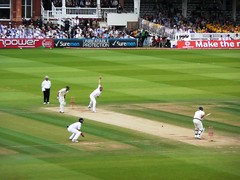
An Australian cricket team in happier days: Perth 2006.
With the Ashes series all but decided in England’s favour. And deservedly so too, perhaps it’s time us Aussies learnt to lose gracefully (hint, hint, Ricky Ponting!). And who better to learn from than the very English who have bested us?

Last Ashes series in Australia, to distract from their teams miserable performance, I read that the Barmy Army took to chanting the following chant:

We’re fat, we’re round, three dollars to the pound!

What’s that? The exchange rate? English fans are singing about the performance of their currency in relation to Australia’s? Yes, that was the case - you gotta love those barmy poms!


So, as a distraction of my own: “English food vs. Australian food” or more specifically “Tropical Fruit vs. Deciduous Fruit”. I must warn my readers, however, that I’m no botanist and I am going to using the terms “Tropical” and “Deciduous” shall we say “loosely”. And, if I happen to claim some mediterranean fruits as “tropical” forgive me, in penance I shan’t include the really unbeatable foods like coffee and chocolate because they don’t grow in Australia.

The "hedgehog" style is a common way...Image via Fir0002Wikipedia
Australian Mangoes
To begin with: Mangoes. As I was surprised to find earlier this year, you can get mangoes in “Old Blightey”, and I was even more astounded to hear a work colleague confess that she didn’t actually like mangoes! But, the reason is, I suspect, that the mangoes you’ll find in Morrisons or Sainsbury’s aren’t really mangoes. I mean, sure technically they are, but no, not really. A mango isn’t sour. Sure, in the early part of the mango season, you’ll find one with some green sour-ish patches, but the ones one sale in Morrisons could be substituted for lemons! To enjoy the real mango experience, you have to come down under, or better yet, visit India - because in all honesty, the mangoes I tried when I was in India beat anything I have had before or since! When you bite into a ripe red and gold mango you’re biting into a summer’s worth of tropical sunshine, a mango is unbelievably sweet like no other fruit. Sweet but mellow and deliciously juicy, you know it’s ripe and ready to be devoured when you can put it to your nose and literally breath-in the decadent excess of sugar it has stored. Mangoes go straight onto the top of the list.

Next, Strawberries. We get strawberries down here in Australia. Great big juicy Queensland strawberries, some as big as apples, and they taste like... they taste like... well, to be honest, they don’t really taste of anything, I don’t know what the big fuss is with strawberries? Or at least I didn’t until my first ever visit to the Northern Hemisphere, Québec, England, Finland, France, all delivered strawberries that were unbelievably sweet and full of flavour. In Australia, strawberries are generally eaten dipped in sugar and a punnet occasionally rots in the fridge uneaten. In England, a punnet might be finished on the same day it was bought, especially if it was bought from the local farmer’s market.

Strawberries gariguettes DSC03052Image via Wikipedia
French Gariguette strawberries
Blueberries. I could say the same for blueberries as I said for strawberries, and for that matter, blackcurrents, raspberries and cherries. I don’t think blueberries and cherries suffer as much as strawberries from the tendency to tastelessness - they simply don’t grow to enormous, watery proportions like strawberries do - but there’s no doubt they taste better when grown in a cold latitude.

Grapefruit. It’s a bit sour, being a member of the citrus family, but if you follow these directions you can’t go wrong. 1) Cut the grapefruit in half. 2) Cut out the white “pith” from the centre. 3) Cut out the flesh of the fruit into “pizza” segments, but be careful not to cut through the skin. 4) Sprinkle 1 teaspoon of sugar over both halves. 5) Repeat step 4 - it is a member of the citrus family remember. 6) Dump another teaspoon of sugar right in the centre from where you removed the pith. 7) With a teaspoon, eat each of the segments you cut. 8) Now here comes the best part, close your eyes and picture yourself stranded on a tropical island where you haven’t had anything to drink for days, lift the grapefruit half to your lips as if it were a cup, now pour the delicious sugary fruit juice into your mouth, being sure to let some of it miss and run down your cheeks and neck in true Robinson Crusoe style!

Now, you can’t do that in England can you?

Ok ok, next fruit. Deciduous this time. Um, how about apples? Nice, but a bit boring. Then plums? Yeah, they’re delicious, but frankly the more sun the better and Australia has more than England. How about peaches? Ditto what I said about plums. Well, we’ll have to choose a tropical then: chillies! Fiery and exciting, forceful and with a take-no-prisoners attitude, definitely not a fruit for the faint-hearted. Sure you can grown them in England as well as in Australia, but whose temperament do they really suit better?

Well, if you’ve been following the Ashes series this summer, you’d have to say: “England”.
Enhanced by Zemanta

The Parasites of European Tourism: Awful Restaurants in Top Spots

For any of the cafés at the Piazza della Signoria, Florence,
expect to pay exorbitant prices.

The greatest problem with going on a tour of the main sites of a new and foreign city is lunch. Where do you go, when you’re hungry from exploring a city that you don’t know very well, you’re miles away from your hotel and you haven’t packed anything to take with you? Occasionally, you find yourself going to familiar fast-food chains just because you’ll know what to expect. But when in Paris, or Florence, or somewhere with a good reputation for food, do you really want to be eating at McDonalds? So you try having a look for a nice restaurant, or café to eat and here comes the real problem: those parasitic restaurateurs that live off of the good culinary reputation of a particular country or city or region to serve you rubbish on a plate and charge the world for it.

Such restaurants and cafés are always to be found in tourist hubs, a pub in Covent Garden, the bistro across from Notre Dame, or the Al Fresco café in Florence’s Piazza della Signoria. They survive because they get their traffic not from their own good reputation, but from the reputation of whatever tourist attraction that they are close to. As David Whitley of Grumpy Traveller has commented:

They know they won’t get repeat trade, they know people on holiday fritter away money at a rate they’d not dream of at home, and they know that the odd upset customer is worth the gain.


“And they’re always the places where service is worst.

But the corollary that no-one seems to notice about this parasitic practice is that the loser in the end (apart from the unhappy customer) is the reputation of the country or the place that is being so parasitically exploited in this way. So much so that, having visited Tuscany I can honestly tell you that although Florence is such a significant city in European history and although it has such great architecture and the Uffizi and Accademia are unmissable, the entire city is a giant tourist trap, and for the real Tuscan experience I would recommend nearby Lucca, which has its own splendid Piazzas, cathedrals and fountains and a significant and interesting history of its own.

And the real big-time loser in this parasitic practice is France. To the extent that you might find a columnist in Britain’s “The Independent” fatuously claim that British food is better than French. For an Australian who’d never been Paris, such a claim would be dismissed as ridiculous, just on reputation alone, even more so for an Australian whose experience of British cuisine was the pub-grub of north Hertfordshire. But for my part, as I had been to Paris, I could see that there was some credibility in the columnist’s claim. Unfortunately, France which, since at least the 50s has enjoyed a pre-eminent position in the culinary world, nowadays suffers from such a rash of mediocre restaurants that I can well imagine that around the world, everyday there are hordes of holidaymakers returning from France with a massive sense of disappointment at the much-vaunted “French cuisine” that they’d heard so much about.

A view of Paris from the Galerie des Chimères ...Image via Wikipedia
A beautiful view from atop the Cathédrale Notre-Dame 
de Paris, but I'm sure that there aren't any great
restaurants to be seen! Tourist hubs like the Île de la
Cité are no-go zones for good food and good service.
For Paris in particular, the world’s most visited city, with 45 million tourists a year, it is a particular problem, and having visited the city four times, I still can’t recommend a restaurant for my readers for a mind-blowing French-food experience. For that, I would urge readers to visit l’Alchemiste in Saumur in the Loire Valley, a place I never would have found were it not for the recommendation of my hosts when staying at Château de Verrières.
Enhanced by Zemanta

Autumn in the Loire Valley

Image via Tom Häkkinen
The town of Langeais
Image via Tom Häkkinen
Leaf-fall outside the Château de Chenonceau
In October, before returning to Australia, Esther and I went on one last continental excursion from the UK. To a part of France we’d never seen before but wanted to visit. The Loire Valley - a region of vineyards, chateaux and an incredible river.

We stayed in a small boutique hotel in the town of Saumur. It’s a fantastic region, quintessentially French, and Autumn was a perfect time to visit as well. Approaching France, as always, from a literary-historic background, what first attracted me to the Anjou region was the knowledge that this was the homeland of the Angevin Kings of England. Henry II, King Richard the Lionheart and John Lackland. This period in history was singularly important in English history, coming as it did, so shortly after the Norman Invasion and which saw the signing of the Magna Carta.

Image via Tom Häkkinen
The Maze in the grounds of Château de Chenonceau
The first Angevin King, King Henry II of Anjou, who married Eleanor of Aquitaine, presided over a realm that extended from the border with Scotland in the North to the Pyrenees in the South, encompassing much more of France than the King of France, Louis VII actually controlled. The Angevin’s origins amongst the French nobility and historical ties to lands in France were to sow the seeds for the Hundred Years War two centuries later. This was also the period, as I’ve mentioned in a previous post, that saw all those fantastic French loan-words enter English, words to do with Gouvernance, Justice and the Court, etc. Not to mention it being the most-romanticised period, a time of troubadours, chivalry, Robin Hood and England’s favourite King: Richard the Lionheart or Richard Coeur de Lion. So I was eager to visit that part of France where the Angevin influence began.

Image via Tom Häkkinen
The Mairie of Chenonceau
But, as I found out, if you’d never read a history book before in your life. You’d still love this part of France. Unlike Provence which is also beautiful, the Loire seems quintessentially French in a way that happily reflects all of your preconceptions. That perfect table at a French cafe, sitting in the dappled sun of plane trees, which you’d hunted Paris up and down for, is in fact much more likely to be found in Tours. Travelling the high-speed rail-link that connects Nantes to Paris, you will come across the most delightful kind of towns, so quaint and picturesque, like the town of Chenonceau, with it’s few streets, Mairie, ecole and bistro, and surrounded by vineyards and woods.

Image via Tom Häkkinen
Grape vines - laden with ripe fruit
Our hotel was likewise a fantastically clichéd chateau. It’s gothic dimensions actually intimidating at night. And the Saturday farmer’s market was really alive with all varieties of mushrooms, berries, fruits and vegetables. When buying a punnet of strawberries I asked whether they were grown locally:

« Qu’est-ce que le provenance de ceux-ci ? »
« Trente kilomètres. »

Image via Tom Häkkinen
The Hôtel de Ville, Tours
Thirty kilometres! That’s local. One day, waiting for the train from Chenonceau, the vines heavy with grapes in the vineyard opposite almost tempted me to jump the ditch surrounding the vineyard and sample some. They did look delicious and fat from a bountiful and verdant land.

Image via Tom Häkkinen
Picnic on the banks of the Cher: Château de Chenonceau
is visible in the background, whilst mushrooms arise from
the Autumnal earth in the foreground.
So with the vineyards, the local produce, the cute little towns with their municipal buildings and symbols of the Republic, as well the chateaux and the history, I couldn’t imagine a better place to visit.
Image via Tom Häkkinen
The gothic lines of Château de Verrières come alive at night.
Enhanced by Zemanta

The Battle of the Ashes

England v Australia 5th Day 2nd Ashes Test @ L...Image by 6tee-zeven via Flickr
England's victory in the last Ashes series in 2009
means they are defending the Ashes in Australia
this summer.
I find myself in the rare position of reading Australian newspaper commentators praying for rain ahead of day 5 of the second Ashes Test in Adelaide tomorrow. This has been a tough year for Australian sport.


Notwithstanding Ian Botham’s supreme confidence that this English side will be the first since 1986/87 to retain the Ashes on Australian soil, my own expectations were for another Australian victory. Australia got off to a good start too, with Peter Siddle’s Hat-trick and Brad Haddin and Mike Hussey’s three-ton partnership in Brisbane, I was able to rattle off a gloating email to some colleagues in the UK.

“Doesn’t this seem familiar?”

But I spoke too soon! England fought back with a determination I don’t remember seeing in an England squad in Australia. After England finally managed to dispatch first Haddin and then Hussey they pulled themselves together and dismissed the rest of the team for 481 - this was after having reached 5/450 at the height of the Haddin/Hussey partnership. Even as my emails were traversing cyber-space I was blithely ignoring the ample evidence of English resolve.

The next day proved un-ignorable. England’s opening batsmen Alistair Cook and Andrew Strauss together produced a century each. The day after, another two centuries, and only 1 wicket. Alistair Cook himself proved invincible to all the attacks of Australia’s bowlers. By the final day of the first test, far from thinking that this test was following a rather familiar pattern of the last two decades, I thought that England were being overly cautious in not putting Ponting’s men in to bat earlier and having a crack at winning the test.

Ricky Ponting at a training session at the Ade...Image via Wikipedia
Australian Captain Ricky Ponting has been feeling
the pressure in this Ashes series
So how did we get to this role-reversal? How did we get so far from the familiar the situation that I can recall from childhood, where if I went home to my older brother after losing a game in any sporting competition, my “did my best” defence was only met with jeers and comparisons with Mike Atherton, whereas now it seems like it’s the Australians who are full of excuses for their poor performance (some commentators, oblivious to what blind freddy could see, are claiming that the pitch has been the cause of these indomitable English batsmen).

Now this morning Australia are 4 for 238 and looking to the skies for rain to interrupt the game and save them from a defeat at the hands of the English.
Enhanced by Zemanta